HTML: All Papers (except Editorials)¶
1. Title¶
1.1. Check that title is in sentence case.
1.2. Check title spelling.
1.3. Check that title is written in black and bold font.
1.4. Check that capitalization of scientific terms is correct. We suggest you use the following procedure if you are in doubt regarding this or that term.
1.5. Check that following Latin terms are written in italics: in vivo, in vitro, in utero, in situ, via. For other Latin terms either italics or plain text is acceptable.
1.6. Check that species and gene names are written in italics.
2. Author List¶
2.1. Check that all author names in author list are separated by commas (,). No other separators allowed.
2.2. Check that author’s name does NOT contain titles and/or degrees (e.g. Dr., Ph.D., M.D., etc.).
2.3. Check that there is no period (or any other punctuation mark) after the last author name.
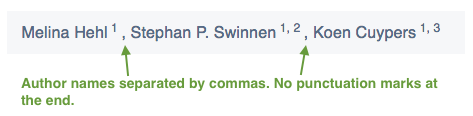
2.4. Check the format of the author name.
Allowed formats:
- FirstName LastName
- FirstName MiddleName LastName
- FirstName MiddleName MiddleName LastName (there can any number of middle names)
- FirstName MN. LastName (MN. are initials of middle names; up to 4 letters)
- FirstName M.N. LastName (M.N. are initials of middle names; up to 4 letters)
- F. MiddleName LastName (F. is an initial of first name)
- F. MiddleName MiddleName LastName (F. is initial of first name and there can any number of middle names)
Important
As a general rule, we don’t want to keep initials for first names. Please notify production team if you notice that an initial is being used for an author’s first name.
LastName cannot be presented as initial.
Please note that last names can be compound, can have prepositions, suffixes, prefixes or be mononyms. For example:
- Compound last names: Garcia-Closas, Gomez Jimenez
- Last name related prepositions: Van den Brandt, van der Ent
- Suffixes: Williams 3rd, Rowland Jr
- Prefixes: McCann, O’Kelly
- Mononym: Govindjee
If you see that author name does not comply to these standards, please notify production team.
2.5. Check that each author name contains a number linked to the affiliation text (i.e. affiliation number). One author name can contain a few affiliation numbers.
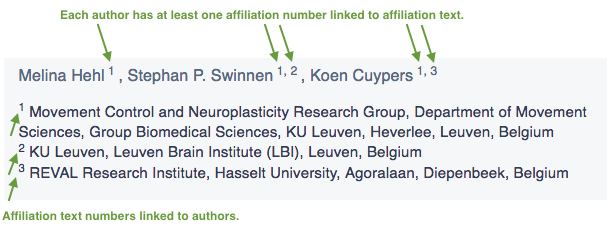
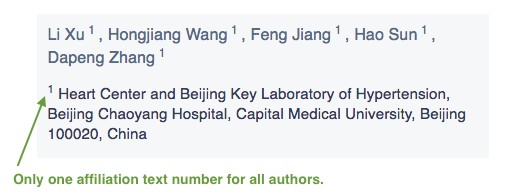
If there is only one affiliation text for all authors, then each author name should have “1” next to it.
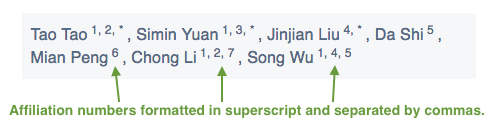
2.6. Check that all affiliation numbers of the author list are separated by commas (,). No other separator is allowed.
2.7. Check that all affiliation numbers of the author list are formatted in superscript. See below.
Note
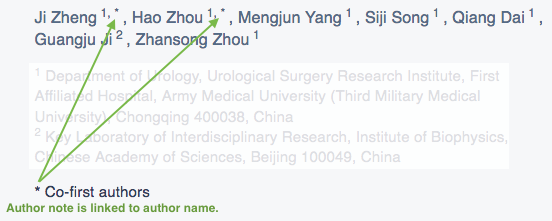
Occasionally you may see a symbol (*, #, †, etc.) next to the author name together with affiliation number. This symbol is related to Author Notes.
Author Notes checks can be found below.
3. Affiliations¶
3.1. Check spelling of English words only
3.2. Check that there are NO street addresses and house numbers included in affiliation.
3.3. Check that country and city names are present in affiliation. State is also required in U.S. affiliations.
2.4. Check that country and city names are NOT written in ALL CAPS (capital letters).
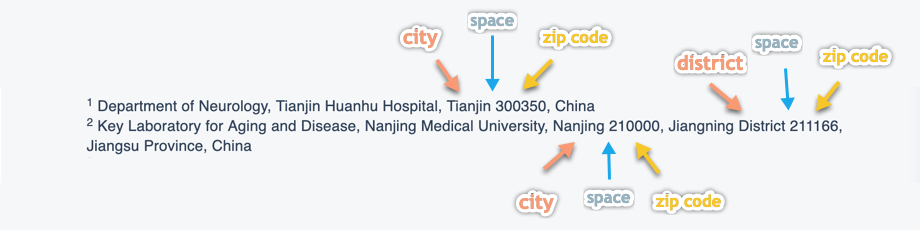
3.5. Chinese affiliations: zip code is allowed for both city and county/district. If zip code is present, it must be positioned after city/county/district and there must be no comma between city/county/district and zip code. Zip code is optional for any of the elements (city/county/district).
3.6. Taiwanese affiliations: Check that “Taiwan” is used for the country. “ROC” and/or “Republic of China” should not be used instead of or in addition to “Taiwan”.
3.7. USA affiliations: check that there is no comma between state and zip code. State must be positioned before zip code. Zip code must be present.
3.8. Non-USA affiliations: check that there is no comma between city and zip code. City must be positioned before zip code. Zip code is optional.

3.9. Check that each affiliation number has only one complete affiliation. One affiliation – one number.
One exclusion: affiliations of Chinese authors, where Key Laboratory combines different institutions. In that case one number can contain two affiliations.
3.10. Occasionally affiliations can contain “Current/Present address:” title. If it is present, check that it has a separate affiliation number and that the title is followed by colon (:).
One address - one affiliation number.
All acceptable combinations of “Current/Present address” are depicted on the screenshot below:

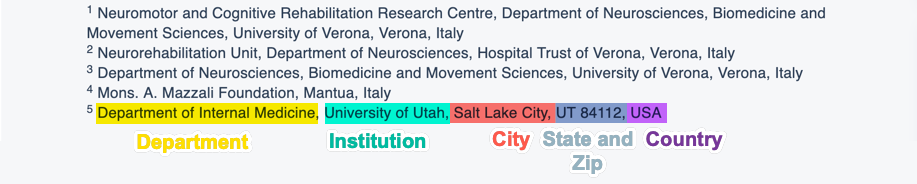
3.11. Check that only commas are used to separate parts of affiliations (i.e. department, institution, etc.).
4. Author Notes¶
Author notes are optional. Article can have several or no author notes.
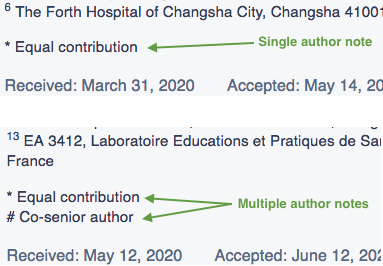
4.1. Check that first word of author notes starts with a capital letter.
4.2. Check that author notes are denoted by symbol (no numbers allowed). Each note should have different symbol.
- First author note should be denoted by: *
- Second author note should be denoted by: #
- Third author note should be denoted by: †
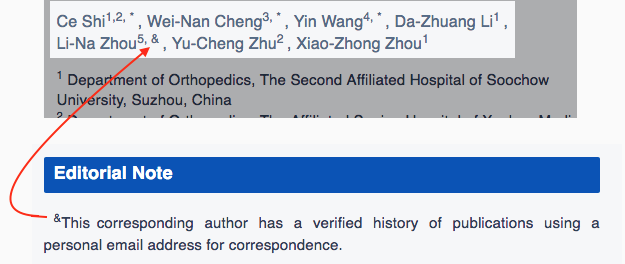
4.3. “&” is also an acceptable symbol in the author list for an author note. However, the note itself should be located in the Editorial Note section with the following text (no other symbol or text allowed):
&This corresponding author has a verified history of publications using a personal email address for correspondence.
4.4. Check that author notes line is written in sentence case.
4.5. Check that there are no punctuation marks at the end of author notes line.
4.6. Check that author notes symbols are formatted in superscript.
4.7. Check that author notes symbol is present next to author name(s).
5. Correspondence¶
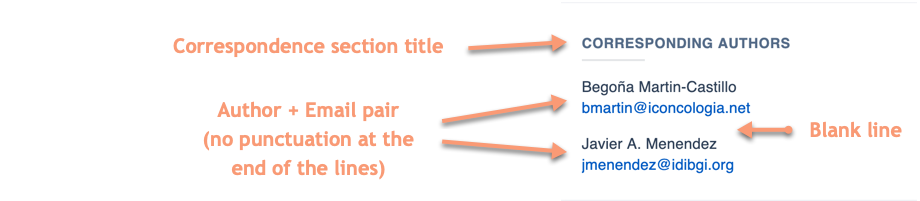
5.1. Check that correspondence section has a title “CORRESPONDING AUTHORS” for more than one author or “CORRESPONDING AUTHOR” for one author (ALL CAPS).
5.2. Check that correspondence section has one or more Author + Email address pairs.
5.3. Check that author’s name does not have any punctuation marks at the end.
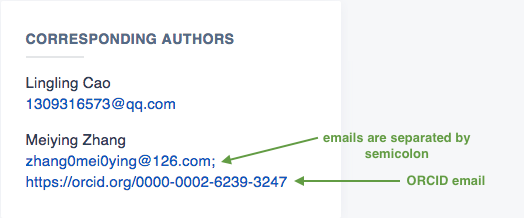
5.4. Check that email line is located below the author’s name and does not have any punctuation marks at the end. Multiple emails should be separated by a semicolon (;).
5.5. Check that multiple Author + Email pairs are divided by a blank line.
5.6. Check that author’s name does NOT contain titles and/or degrees (e.g. Dr., Ph.D., M.D., etc.).
5.7. Check that email address is hyperlinked.
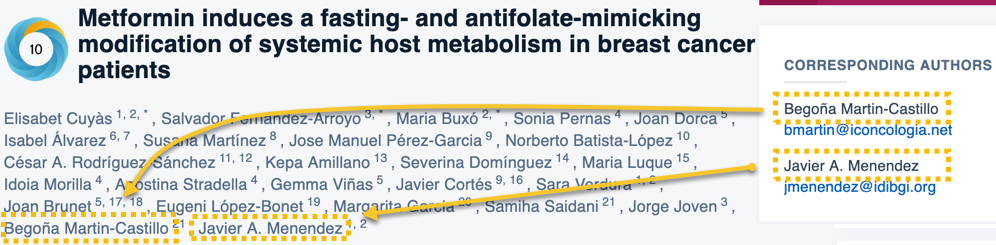
5.8. Check that author’s name completely matches corresponding name in the author list (including the middle initials if any).
6. Keywords¶
6.1. Check that Keywords section has a title “KEYWORDS” (ALL CAPS).
6.2. Check that keywords are written in lower case, unless proper nouns as well as exceptions such as special terms, genes, proteins, species names etc, which normally start with capital letter.
6.3. Check that article has at least 1 keyword and not more than 8 keywords.
7. Dates¶
7.1. Check that dates section has titles “Received:”, “Accepted:”, “Published:” (title case and followed by colon (:)).

7.2. Check that month is spelled out as a word and dates are in-line with the following format: Month Day, Year (e.g. June 1, 2017, April 12, 2016, December 31, 2015, etc.) Note: if a day is presented by single digit, there should be no leading 0.
7.3. Check spelling of the month.
7.4. Check that Received date is older than Accepted date (i.e. we cannot publish before we accept).
Note
Pay attention to years.
8. Copyright¶
8.1. Check that copyright section has a title “Copyright:” (title case).
8.2. Check that copyright string starts with copyright symbol (©) and is followed by a YEAR.
8.3. Check that the YEAR is followed by:
Last name of first author et al.
or
two last names divided by “and” and followed by a period (.) (if there are only two authors in the article)
and followed by:
This is an open access article distributed under the terms of the Creative Commons Attribution License (CC BY 3.0), which permits unrestricted use, distribution, and reproduction in any medium, provided the original author and source are credited.
8.4. Check that last name of first author matches last name of the first author in the author list. In case of 2 authors, check that last names match names in the author list.
8.5. Check that “Creative Commons Attribution License” is a working hyperlink that leads to https://creativecommons.org/licenses/by/3.0/.

9. Reference Callouts¶
9.1. Check reference callouts in the text:
- Check the format of reference callouts:
[N] (where “N” is the order number of the corresponding reference)Examples:[1][1, 2][1–3][1, 3–4]
- Check that only comma (,) and en dash (–) are used as a separators. No other separators are allowed.
- Check that there is a space after comma (,) and no space before and after en dash (–).
- Check that all reference callouts are in plain text and a number (or numbers in case of ranges) is hyperlinked (callouts will not be hyperlinked if they appear in figures).
9.2. Check that callout number for each of the references is present in the text or is covered in the range of numbers. i.e. in the range of [1–3] reference 2 is not present in the text, but covered in the range. This case is acceptable.
Callouts can be found in text, figures and tables.
9.3. Check that there are no callouts for non-existing references (i.e. there is a callout, but there is no reference).
9.4. Check that there are no references for which callouts are missing (i.e. there is a reference, but there is no callout for it).
9.5. Check that reference callouts appear in linear order throughout the manuscript. 1, 2, 3 and so on. Once a reference has initially been called out, it can be called out again in any order. For example, 1, 2, 3, 1, 2, 4 is OK. Sometimes callouts can appear to be out of linear order due to being called out in tables - This is OK as long as all other callouts are following linear order.
If one or more references or callouts are missing or are being called out of linear order in the text, please notify production team.
10. References¶
10.1. Author List¶
10.1.1. Check that author names in the list of authors are in-line with the following format:
LastName INITIALS optional Suffix (e.g. Sr, Jr, 2nd, 3rd, 4th)
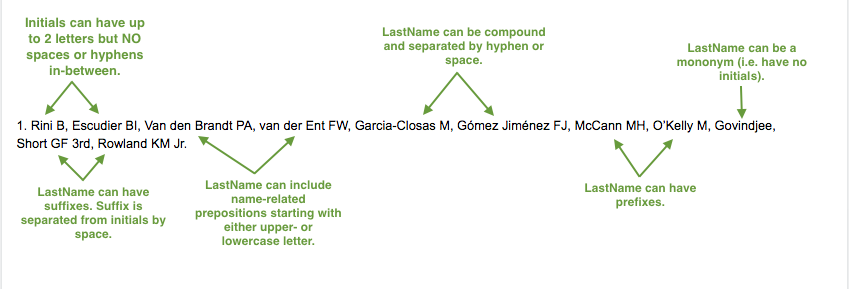
10.1.2. Check that initials have no more than 2 letters and have NO hyphens or spaces in-between.
10.1.3. Check that all mononyms (names which have no initials) are “true” mononyms (check PubMed site).
10.1.4. Check that list of authors contains no more than either:
- 13 authors followed by “et al.” OR
- 14 authors


10.1.5. Check that authors are separated by comma (,) followed by space.
10.1.6. Check that et al is separated from list of authors by comma (,).
10.1.7. Check that there is a period (.) either after the last author name (if there are less or equal to 14 authors), or after et al (if there are exactly 13 authors + et al), or after group authorship (if present).
10.1.8. List of authors can contain group authorship (see screenshot below). Check that group authorship is positioned at the end of list of authors. Other positions are not allowed.
10.1.9. Group authorship must be separated from author list by comma (,) and “and” word. Group authorship is not counted against total number of authors in the author list quota.


10.1.10. If there are multiple group authorships, then those should be separated by comma (,) and “and” word.

10.2. Reference Title (in-house)¶
10.2.1. Title can be written in sentence case, title case or in ALL CAPS. All these formats are allowed. Format of title is allowed to be inconsistent across all references in the article.
10.2.2. Check that title is followed by a period (.). There should be a space after period.
10.3. Citation-Data (in-house)¶
Attention
- This section is applicable ONLY to in-house journals:
- Oncotarget, Oncoscience, Aging (Albany NY), Genes Cancer.
Citation data is a part of a reference, which contains journal title, year, volume, pages, doi and PubMed link.
10.3.1. Check that citation data has correct journal title. The following titles are allowed:
OncotargetOncoscienceAging (Albany NY)Genes CancerThis is the only acceptable spelling. No variations are allowed.
10.3.2. Check that journal citation-data has the following elements in this order:
JournalTitle. year; volume: pages. DOI [PubMed]
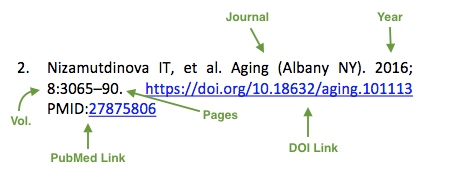
- Journal title should be followed by period (.) There should be a space after period.
- Year should be presented in full (4 digits) and should be followed by semicolon (;). There should be a space after semicolon.
- Volume should be followed by colon (:). There can be a space after colon (but this is not mandatory).
- Page numbers must be written in shortened format (12063-74) and followed by a period (.). There should be a space after period. Occasionally, there are cases where a reference may only have one page number, which is fine.
- DOI must be present and in “https://doi.org” format. It should be highlighted in blue and should be an active link leading to the correct article page. There must be no period at the end.
- “[PubMed]” link must be present (when available), should be highlighted in blue and should be an active link leading to the article page on the PubMed website. There must be no period at the end.
10.3.3. There can be references to the articles which have been published “ahead of print”. The format of citation data for such articles is as follows:
JournalTitle. year. [Epub ahead of print]. DOI [PubMed]
- Check that there is a period (.) after year followed by a space.
- Check that there is a period (.) after “[Epub ahead of print]” followed by a space.
- Check that “[Epub ahead of print]” appears after year and before DOI.
- If you come across an Epub reference, be sure to verify whether publishing information has since been released. If publishing information is available, then please add vol, pg numbers, etc. and format as directed above in section 10.3.2.

10.4. Citation-Data (other journals)¶
Attention
This section is applicable to all journals except for in-house journals.
Citation data is a part of a reference, which contains journal title, year, volume, pages, doi and PubMed link.
10.4.1. Check that journal citation-data has the following elements in this order:
DOI [PubMed]
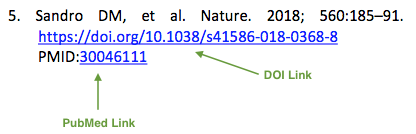
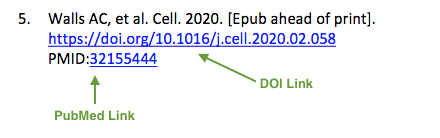
- DOI must be present (when available) and in “https://doi.org” format. It should be highlighted in blue and should be an active link leading to the correct article page. There must be no period at the end. When checking for DOI’s, please consult the PubMed site, https://www.crossref.org/ or the applicable journal website, if necessary.
- “[PubMed]” link must be present (when available), should be highlighted in blue and should be an active link leading to the article page on the PubMed website. There must be no period at the end.
10.4.2. If you come across an Epub reference, be sure to verify whether publishing information has since been released. If publishing information is available, then please add vol, pg numbers, etc. and format as directed above in section 10.3.2.
10.5. General Checks¶
10.5.1. Check for duplicates in the reference list.
If you find duplicate references, please contact production team and ask to correct the reference list.
10.5.2. Check for references translated into English from another language (usually you can spot those by keywords: translation, translated from, in Chinese, in French etc). Those references should comply to the following format:
Author list. [Title of the article]. Journal Name. 1072; 1: 1-2. (doi, if available) (PubMed link, if available)Example:34. Yang XM, Yang H. [Expression of high mobility group box-1 in the lung tissue and serum of patients with pulmonary tuberculosis]. Zhonghua Jie He He Hu Xi Za Zhi. 2013; 36:497-500.
10.5.3. Check for references containing journal title in English and original language (e.g. “International journal of cancer” and “Journal international du cancer”). Remove title in original language and leave English version. If there is just a “foreign language” version present, it is OK to leave that version (no need to find English one). Consult PubMed if in doubt of the correct journal name.
10.5.4. Check for extra information in the references (i.e. in addition to “standard” information). Remove all extra information.
Example:“:official publication of the society of…”
10.5.5. Remove any instances of “[Internet]”, “[pii]” Accessed dates (ex: “Accessed November 6, 2017.”) and empty (blank) doi.
10.5.6. Remove “PMID” and “PMCID” details, if present in any reference.
10.6. Websites¶
10.6.1. There is no standard for website references. Authors are allowed to accompany a web link with any information they think appropriate.
10.6.2. Check that website link is valid (i.e. it points to the referenced web resources, rather to error or other irrelevant page).
If the link is not valid, please notify production team.